![logo-black.png]](https://knowledgebase.moorgateandrology.co.uk/hs-fs/hubfs/Moorgate%20Website%20Images/logo-black.png?height=40&name=logo-black.png)
A buried penis (sometimes called a hidden penis) is a condition in which the penis is partially or completely concealed beneath the skin or fat of the pubic area.
This can make the penis appear much smaller than it actually is and may cause difficulties with urination, hygiene, and sexual confidence. At Moorgate Andrology, our Urologists regularly treat this distressing condition with proven surgical and non-surgical techniques.
What Causes a Buried Penis?
A buried penis can occur for several reasons:
1. Congenital Conditions
In some men, the penis has been buried since birth due to congenital abnormalities such as:
-
Congenital megaprepuce – excess foreskin covering the penis
-
Webbed penis – fusion between the scrotum and the shaft
Many patients tell us they have experienced this condition since childhood.
2. Excess Fat Tissue
One of the most common causes of a buried penis in adults is excess fat in the pubic area.
When the pubic fat pad becomes enlarged—often due to weight gain or obesity—it can physically conceal much of the penile shaft.
3. Scarring
Scarring after circumcision or other penile surgery can cause the skin to tighten and pull forward, covering the penis.
At Moorgate Andrology, we frequently treat men who have developed a buried penis following complications from circumcision.
4. Inadequate Skin Growth
Some conditions lead to insufficient penile skin, which prevents the shaft from extending properly and causes it to retract inward.
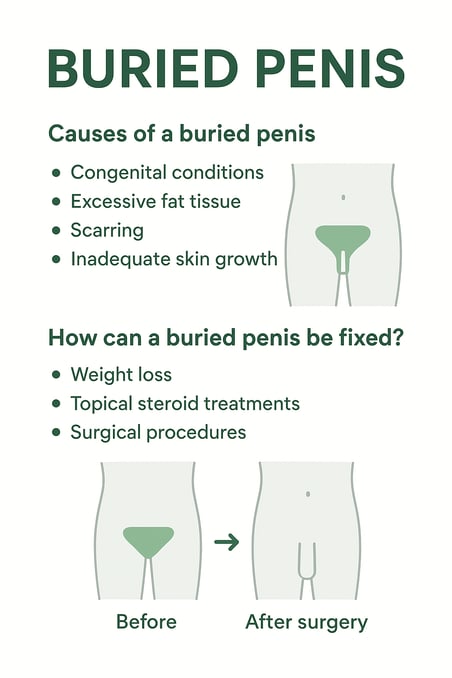
How Can a Buried Penis Be Fixed?
The appropriate treatment depends on why the penis is buried, the severity of the condition and the individual's overall health. Your urologist will assess the underlying cause before recommending a treatment plan.
1. Weight Management
Where excess fat in the pubic area contributes to a buried appearance, weight loss may help reduce the fat surrounding the base of the penis and improve how much of the shaft is visible. Weight management can also support general health and may be beneficial before surgery.
However, weight loss alone may not resolve the problem, particularly where excess skin, scarring or other anatomical factors are involved.
2. Treatment of Inflammation and Skin Conditions
Where inflammation or an underlying skin condition contributes to the problem, medical treatment may be appropriate. Depending on the diagnosis, this could include prescribed topical medication, such as corticosteroid creams.
These treatments are not suitable for every case of buried penis and will not correct structural problems such as significant excess tissue or scar formation. A clinician should assess the cause before treatment is recommended.
3. Liposuction of the Pubic Area
Where excess fat in the pubic mound contributes to a buried appearance, liposuction may be used to reduce the fat surrounding the base of the penis and expose more of the visible shaft.
This procedure is most appropriate when excess fatty tissue is a significant contributing factor. It may not be sufficient on its own where excess skin, scarring or other anatomical factors are responsible. Your urologist will assess whether liposuction is suitable, either alone or as part of a combined surgical approach.
4. Scar Release Surgery
Where scar tissue or skin contracture is contributing to a buried penis, surgery may involve releasing the affected tissue to allow more of the penile shaft to become visible.
Depending on the underlying anatomy, scar release may be combined with other procedures, such as anchoring techniques or removal of excess pubic tissue. The appropriate approach will depend on the extent and location of the scarring, and outcomes vary between patients.
5. Penile Implant Surgery
If a man has significant erectile dysfunction alongside a buried penis, a penile implant may be considered as a treatment for the erectile dysfunction.
A penile prosthesis is designed to provide rigidity for sexual activity; it does not, by itself, correct the underlying causes of a buried penis. Other procedures may be needed to address excess tissue, scarring or anatomical restriction.
Implant surgery is generally considered when other appropriate erectile dysfunction treatments have been unsuccessful or are unsuitable. Your urologist will assess whether this option is appropriate and explain the potential benefits, risks and alternatives.
Getting Help at Moorgate Andrology
If you believe you have a buried penis, the first step is to schedule a consultation with our Specialist Urologist, Dr Nenad Djakovic.
He will assess the cause, explain your treatment options, and help you plan the best pathway to recovery.
Most men who undergo buried penis surgery at Moorgate report restored confidence and a fulfilling sex life.